Agora-1: The Multi-Agent World Model
Agora-1 enables multiple participants—human or AI—to share and interact within the same world simulation in real-time

Oliver Cameron
May 18th, 2026
Today we're excited to release Agora-1, the first in a series of multi-agent world models exploring how world models can enable new and powerful shared experiences across gaming, robotics, defense, education, foundation models, and more. World models are powerful tools for generating high-fidelity simulations of arbitrary environments, and until now they've been limited to a single active participant within those simulated worlds. With Agora-1, we introduce multi-agent world simulations.
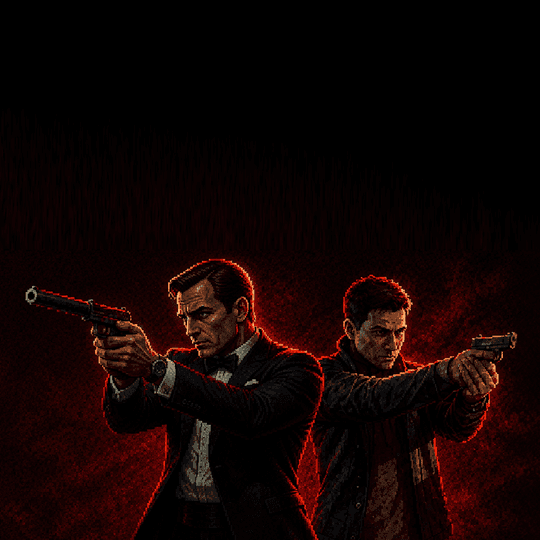
To explore multi-agent world models, we turned to GoldenEye, a game many on the Odyssey team loved growing up. Games have long served as a useful environment for AI research, with systems trained in Atari, Minecraft, StarCraft, and now GoldenEye.
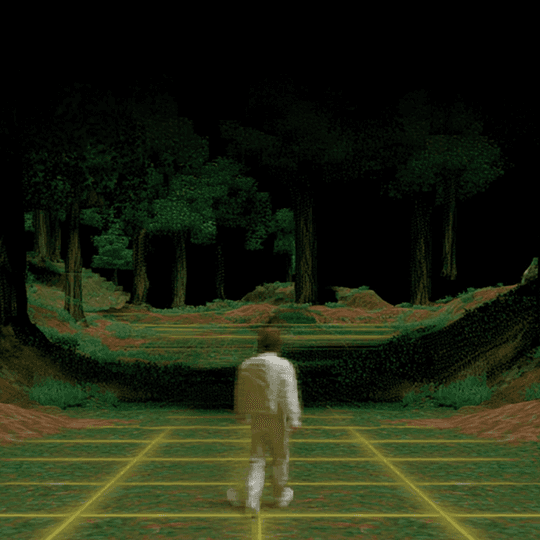
Agora-1 allows up to four players to interact within the same generated world in real time. Players are matched into a shared deathmatch simulation, where every participant interacts with the same generated world simultaneously. Everything you experience is generated by Agora-1 in real time, with the model simulating player interactions from their actions, maintaining a shared world state across participants, and streaming generated pixels to every player simultaneously. In effect, Agora-1 functions as a learned game engine.
A shared deathmatch simulation, powered by Agora-1
From Single-Agent to Multi-Agent World Models
Traditional world models combine simulation dynamics and rendering within a single model. To date, there have been several approaches exploring multi-agent interaction in world models, including Multiverse, Solaris, and MultiGen. Multiverse concatenates agent states into a single “split-screen” representation, effectively treating multiple players as one world state. Solaris instead concatenates each participant along the sequence dimension of a single autoregressive diffusion transformer, producing a more robust shared simulation. However, this approach does not scale linearly with the number of players due to the growth of the model context. Additionally, both Multiverse and Solaris struggle to robustly maintain consistency when players lose sight of one another.
Agora-1 explores a different direction, by decoupling simulation and rendering. Similar to MultiGen, Agora-1 maintains an explicit shared world state between participants. However, we adopt a different approach to modeling simulation dynamics and rendering from that shared state. By separating these functions, Agora-1 can generate consistent views of the same simulated world from multiple independent viewpoints, enabling applications such as multiplayer games, robotics, and multi-view simulation.
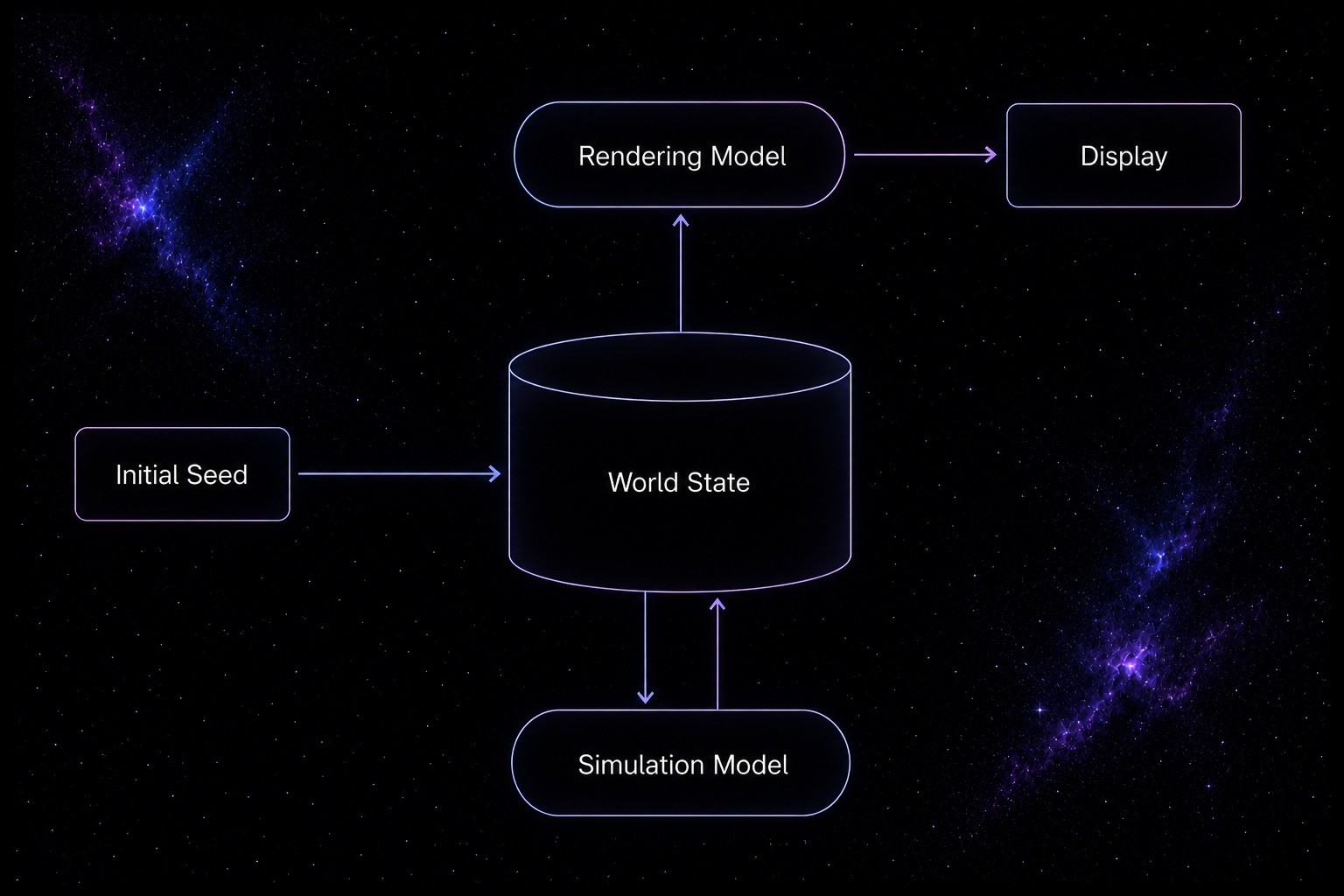
The architecture of Agora-1
Learning Shared World State
Agora-1 learns two distinct functions. First, it learns how the world state evolves over time in response to player interaction. To do this, we train a model directly on the internal state of one or more games—in the case of Agora-1, GoldenEye. This model learns the underlying gameplay dynamics and how state transitions occur from player actions. Second, Agora-1 learns how to render that shared state visually. This is accomplished using a DiT-based world model conditioned directly on the shared game state, rather than prompts, images, or other traditional conditioning signals.
You can think of this separation as loosely analogous to the structure of a modern game engine. The difference is that both components are entirely learned systems. They do not rely on hard-coded gameplay logic or rendering rules, but instead learn directly from data.
Both models introduce unique research challenges. Discrete game state is structurally different from the continuous visual domains that most DiT-based world models operate over, requiring architectures specifically designed for gameplay state modeling and large amounts of structured training data. At the same time, the rendering model must learn to generate consistent visual representations of the same shared state from multiple viewpoints simultaneously. One consequence of this architecture is that the underlying game state can be manipulated directly, allowing Agora-1 to generate entirely new levels while preserving gameplay dynamics consistent with the source games.
The world state of Agora-1 tracks health, position, and more of each agent
Expanding Multi-Agent Interaction to Foundation Models
Scaling Shared World State
Today, Agora-1’s state model is relatively simple. This is not a fundamental limitation. In principle, the internal state representation can scale arbitrarily, enabling increasingly complex simulations and gameplay dynamics. Over time, we expect these systems to generalize across rules and state representations, allowing entirely new experiences to be generated directly from user interaction with the model.
Our broader research focus is understanding how multi-agent interaction can extend to foundation world models without compromising their open-ended behavior or generality. We believe this is achievable through learned systems rather than explicit hand-authored coordination mechanisms. Research environments such as Agora-1 provide a controlled setting for studying these problems.
Multi-Agent Reinforcement Learning
Agora-1 is also a useful environment for reinforcement learning research. We believe progress toward more general agents is increasingly bottlenecked not by model architecture, but by the experiences available during training—specifically, an agent’s ability to actively seek out interactions that improve its own capabilities. Traditional world models only support a single interacting participant, limiting the types of reinforcement learning environments they can support. This includes our recent work on PROWL, where adversarial policies are trained to expose failures in a world model and generate new training data from those failures.
PROWL is a novel RL-driven adversarial framework where an RL agent explores game environments
Agora-1 removes this single-agent restriction. As the number of participants increases, the joint interaction space grows combinatorially, and passively collected demonstrations cover an increasingly small fraction of meaningful interactions: collisions, coordinated movement, contested objectives, and other emergent behaviors. Multi-agent reinforcement learning provides a scalable mechanism for generating this missing data through open-ended interaction. Over time, agents and world models can co-evolve, continuously pushing one another into increasingly difficult regimes.
Imagined Multi-Agent Training
We also believe Agora-1 can serve as a generative multi-agent simulator in its own right. A multi-agent world model is effectively a learned cooperative and competitive simulation environment. Policies trained entirely within these generated worlds may generalize to unseen environments and unseen interacting partners without requiring access to the original game. Agora-1 provides a useful foundation for this type of imagined training, enabling competitive agents, cooperative agents, and mixed populations that learn entirely within generated environments.
Beyond Games
Finally, the architecture behind Agora-1 is not limited to games. Many real-world systems require multiple agents operating within the same shared environment. Collaborative robotics is one example, where robots must jointly reason about actions, space, and interaction with one another. More broadly, multi-agent world models may enable new forms of interactive systems that are difficult to achieve with traditional simulation or game engine architectures. We are excited to see what researchers and developers build with these models.
A shared deathmatch simulation, powered by Agora-1
Experience Agora-1 Today
We believe multi-agent world models open the door to an entirely new class of interactive systems. Agora-1 is an early research preview, but it points toward a future where world models can support shared interaction, emergent gameplay, collaborative robotics, and agents learning together inside simulated worlds. Combined with systems like PROWL, which enables world models to improve through active exploration and discovery, we think these approaches could eventually form the foundation for training more advanced forms of intelligence inside open-ended simulated worlds.
The Team That Brought This to Life
Agora-1 was made possible by the amazing Odyssey team.
Aravind Kaimal, James Grieve, Sirish Srinivasan, Vinh-Dieu Lam, Zygmunt Łenyk.
Ahmad Nazeri, Ahmet Hamdi Guzel, Amogh Adishesha, Andy Kolkhorst, Ben Graham, Derek Sarshad, Fabian Güra, Finley Code, Jenny Seidenschwarz, Jesse Allardice, Jessica Inman, Jonathan Sadeghi, Kaiwen Guo, Kristy McDonough, Nicolas Griffiths, Nima Rezaeian, Richard Shen, Robin Tweedie, Sarah King, Tobiah Rex, Vighnesh Birodkar.
Jeff Hawke, Oliver Cameron.